Two 2024 Rom-Coms Reinvent How Anime Characters Hide True Feelings
Crunchyroll has built a reputation for simulcasting an impressive variety of anime each season, and the summer of 2024 proved no exception. Among the dozens of titles that aired, two romantic comedies stood out for an unusual thematic overlap. Pseudo Harem and Alya Sometimes Hides Her Feelings in Russian both feature a female lead who expresses her true feelings to her love interest, yet the manner of that expression deliberately distorts or masks the meaning. In a genre where miscommunication and hasty backpedaling often rule, these series offered a refreshing variation. The common romantic comedy trope usually involves characters failing to communicate, or if they do speak, misinterpreting everything. In these two shows, however, the heroines actually say exactly what is on their minds. Alya does so in a different language, while Rin does so by attributing her words to another character she is acting as.

The Shared Premise of Masked Honesty
The central similarity between the two series is easy to outline. In a conventional romantic comedy, the unofficial couple rarely communicates with any clarity. Words are either misinterpreted, or the truth accidentally slips out and is quickly retracted. Alya Sometimes Hides Her Feelings in Russian and Pseudo Harem invert that pattern. The heroines do not hold back their feelings, but they encode them. Alya speaks Russian to a boy who, unbeknownst to her, understands the language. Rin performs a rotating cast of "dere" personas, using each one to voice emotionally charged lines that Eiji cannot confidently attribute to her real self. In both cases, the confession is genuine, but the packaging prevents it from registering as a straightforward romantic admission.
This shared device created a fascinating point of comparison during the same season. Viewers who watched both series could appreciate how a single idea—masked honesty—could be taken in two very different directions. One show leans into dramatic irony and the slow burn of an inevitable revelation. The other uses role-play to deconstruct anime archetypes and explore the boundaries between performance and sincerity.
Alya Sometimes Hides Her Feelings in Russian: The Weight of a Secret
In Alya Sometimes Hides Her Feelings in Russian, the gimmick is unusually rare for romantic comedies. Masachika, the male lead, can actually understand Russian. This means that when Alya mutters affectionate or teasing lines in her native language, he is fully aware of their meaning while she believes she is speaking privately. The early tension of the series revolves around his efforts to conceal that comprehension. He gets quiet courage from knowing how she feels, and he enjoys watching her reactions when he says certain things. The dynamic gives him a subtle power advantage, but it also places him in a precarious position.
The anime maintains this formula for quite some time without introducing drastic changes. For some viewers, that repetition might feel stretched. However, the show compensates by implying a future conflict that hangs over every scene. A girl from Masachika's childhood exists, and she is the reason he can understand Russian in the first place. Her eventual appearance is treated as inevitable. When that happens, Alya will likely learn that Masachika has known what she was saying from the very beginning. The emotional fallout could be severe, as she would feel exposed and perhaps betrayed by the one boy she trusted. This looming possibility keeps the audience on edge, even when the present-day episodes feel light and playful.

Pseudo Harem: Confession as Performance
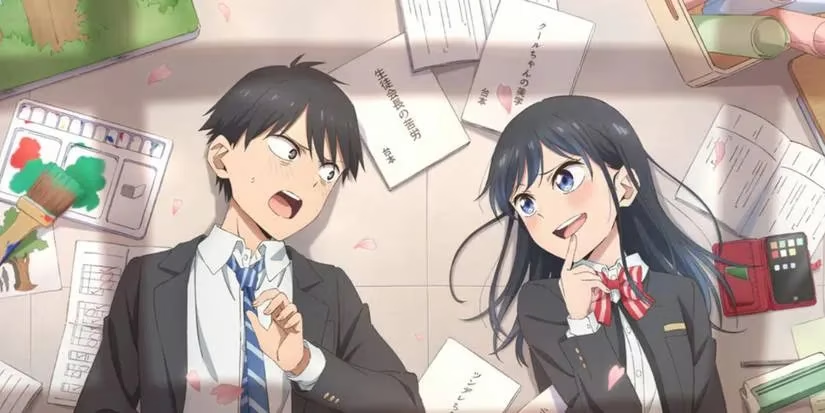
Pseudo Harem approaches the same core idea from a more overtly comedic angle. Rin creates a small harem of personalities for Eiji, each one modeled after a different anime "dere" archetype. The performance fulfills one of Eiji's fantasies, and it becomes the primary vehicle for Rin to say things she could never say as herself. Eiji, for his part, cannot always tell when Rin is being genuine or when she is simply playing a role. That uncertainty is exactly what makes the device work. Her true feelings are hidden in plain sight, scattered across multiple fictional identities.
One of the series' more interesting decisions occurs in its second episode. The classic "sick day" scenario is a rite of passage for romantic comedies. A conventional show would have the heroine care for the boy while he sleeps, perhaps whispering a confession that he cannot hear. Pseudo Harem skips over those moments entirely. It jumps from the setup to the moment he wakes up. The reason is rooted in the show's formula: every meaningful interaction depends on both characters being awake so that Eiji can react to Rin's impressions. The subversion is not arbitrary. It was a deliberate structural choice made to protect the series' central storytelling mechanism. This kind of internal logic makes the series more than a simple gimmick.
Key Differences at a Glance
The two series share a surface-level similarity, but their internal mechanics differ in meaningful ways. The table below summarizes the key points of divergence.
| Aspect | Alya Sometimes Hides Her Feelings in Russian | Pseudo Harem |
|---|---|---|
| Method of masked confession | Speaking in Russian | Acting as different "dere" personas |
| Does the love interest understand? | Yes, Masachika understands Russian | No, Eiji cannot always tell when Rin is serious |
| Primary source of tension | Masachika hides his knowledge; future exposure looms | Eiji's uncertainty about Rin's true self |
| Narrative approach | Prolonged running gag with an implied dramatic payoff | Comedic deconstruction of anime archetypes |
| Handling of romantic tropes | Plays the language barrier straight but with dramatic irony | Skips or subverts typical moments to preserve its formula |
A Season of Thematic Resonance
The fact that these two series aired simultaneously on Crunchyroll made the comparison almost unavoidable for observant viewers. In previous seasons, a show like My Clueless First Friend might have subverted the sick-care trope because of its characters' youth and innocence, but it stood relatively alone. That was not the case in the summer of 2024. Pseudo Harem and Alya Sometimes Hides Her Feelings in Russian formed a natural pair, each illuminating a different side of the same narrative coin.
From a 2026 perspective, both series remain useful examples of how romantic comedies can innovate within familiar constraints. Alya's bilingual confession and Rin's theatrical personas are not merely tricks. They are ways of asking what honesty actually means when the person hearing it cannot recognize it. In a genre full of characters who say too little, these heroines say too much—and that excess becomes the central drama.
🎭 Ultimately, the summer of 2024 demonstrated that even the most crowded anime seasons can produce thematic echoes. The masked confessions of Alya and Rin offered a reminder that true feelings rarely arrive as plain, uncomplicated declarations. Sometimes they are whispered in another language. Sometimes they are spoken by a character who does not exist.