Kurt Russell’s Favorite Movie Is a 1943 Romance – And It Explains Everything
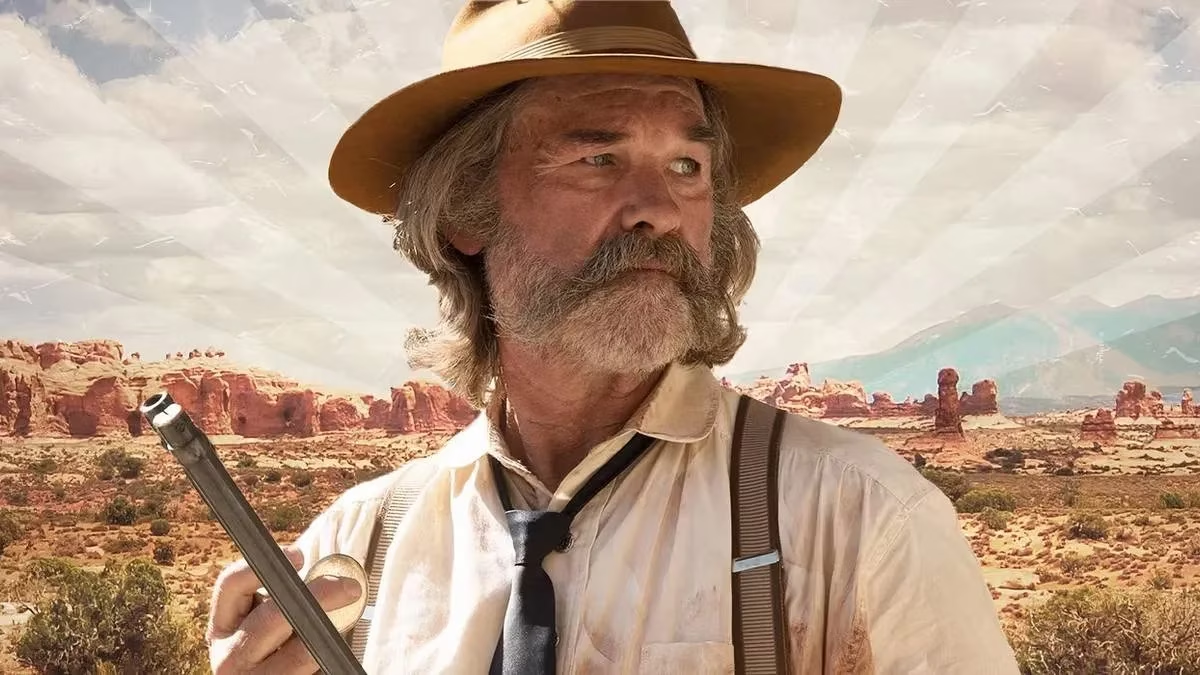
It is 2026, and Kurt Russell still makes a face every time someone calls him a Western icon. Sure, the man has squeezed into dusty boots more than once, delivered drawling one-liners in Tombstone, and chewed scenery as a frontier sheriff in Bone Tomahawk. But when the cameras stop rolling and the Stetson comes off, Russell rushes not toward the next saloon brawl but toward a black-and-white love story that was filmed a full decade before he even existed. His all-time favorite movie is Casablanca, the 1943 masterpiece that marries war, romance, noir, and enough quotable lines to fill a bartender’s notebook. This is not the confession of a cowboy; it is the secret decoder ring for every strange, brave, and morally tangled character Russell has ever played.
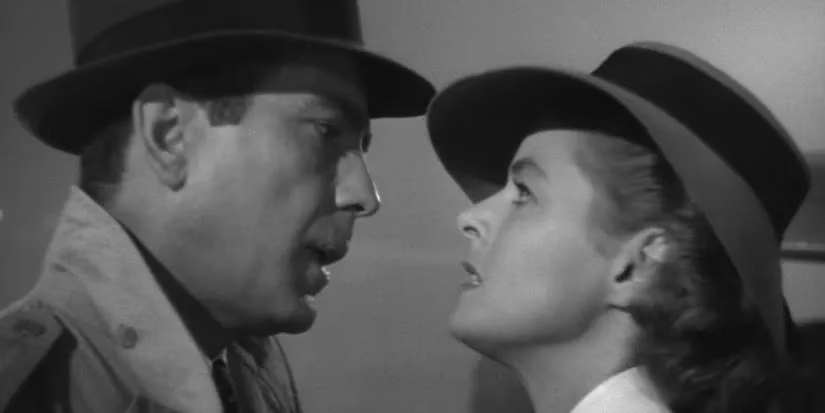
An outsider might expect Russell to worship a John Ford epic or a Howard Hawks shoot-’em-up. Instead, he once told entertainment reporter Cindy Pearlman for the book You Gotta See This: “Anytime I see Casablanca on TV, I’m stuck. I’m going to watch the entire thing.” And no, he doesn’t mean he’s stuck like a tractor in mud; he’s stuck like Rick Blaine staring at an old photograph, unable to look away. Russell’s praise doesn’t stop there. He calls the dialogue “the best in any movie ever” and the story “the most emotionally satisfying film ever made.” For an actor who has body-slammed aliens in The Thing, growled through a dystopian Manhattan in Escape from New York, and morphed into a living planet in Guardians of the Galaxy Vol. 2, this is practically a love letter to subtlety.
Casablanca did not simply charm one rugged leading man. The film sits on a gilded throne with a 99% Rotten Tomatoes score, routinely topping greatest-movies-of-all-time lists. Its plot—nightclub owner Rick Blaine reconnecting with old flame Ilsa Lund and deciding whether to help her and her resistance-hero husband flee the Nazis—sounds almost cliché now, but only because the movie invented the clichés. The dialogue has aged like fine champagne. Even viewers who have never seen the whole picture can hum “As Time Goes By” and mutter “Here’s looking at you, kid” as if they just invented cool.
Yet Russell’s obsession goes deeper than nostalgia. He once explained, “In my mind, the message is about people facing their moment of truth.” That sentence is the skeleton key. Suddenly every Kurt Russell performance starts to resemble a Rick Blaine who swapped a white dinner jacket for a flamethrower, an eye patch, or a sheriff’s badge.
Look at R.J. MacReady in John Carpenter’s The Thing. A cynical helicopter pilot trapped in an Antarctic research station, MacReady spends the entire movie snarling into a whiskey bottle and staring down a shape-shifting horror. His moment of truth arrives with a blood-test scene that crackles with paranoia: every man must discover if he is still human. The finale leaves MacReady sharing a freezing death with Childs, their mutual suspicion dissolving into a grim, accepting smirk. That’s straight out of the Rick Blaine playbook—doing the hard, right thing even when nobody will applaud.
Snake Plissken in Escape from New York wears a permanent scowl, yet he also walks the line between self-preservation and reluctant heroism. The government betrayed him; now they want him to rescue the president from a walled-off Manhattan hellscape. He could walk away. Instead, he skulks through the ruins with a ticking bomb in his neck. The moment of truth? When he swaps the cassette tape at the end, spitting in the eye of authority while still doing the job. Rick Blaine would have raised a glass.
Even in projects that seem miles away from the Moroccan desert, the archetype holds. Sheriff Hunt in S. Craig Zahler’s brutal Bone Tomahawk is a good man out of his depth, steering a rescue posse into cannibal country. He faces terror with a trembling resolve that feels far closer to Humphrey Bogart’s weary nobility than to John Wayne’s swagger. And let’s not forget Stuntman Mike in Death Proof, a role so unhinged it seems allergic to Casablanca’s romance. But peel back the tire rubber: Stuntman Mike is a dark mirror of Rick. He’s a man who has already made his choice—to be the monster—and his moment of truth is the last, defiant scream before he pays for it. Kurt Russell, the genre chameleon, keeps finding new ways to ask the same question Casablanca asked in 1943: what do you do when the world forces your hand?
What makes this lifelong cinematic love affair even funnier is timing. Russell was born in 1951. Casablanca premiered in January 1943, smack in the middle of World War II—a fact the film itself addressed with uncanny nerve. Its script threaded real-world anxiety into a romantic triangle without alienating audiences who were shipping off to battle or rationing sugar at home. The film didn’t just reflect its era; it elevated it. Russell, a kid who would grow up to swing baseball bats in The Battered Bastards of Baseball and brawl with Elvis Presley in made-for-TV movies, somehow soaked up that very same juice. Now, at 75 years young in 2026, he still glows when he talks about it.
No Casablanca sequel ever materialized, despite the ending’s tantalizing mist. Rick and Captain Renault walk off into the fog, promising a beautiful friendship. That open door left a permanent ache in film history, but perhaps Russell has been filling the gap his own way. Every time he squares his jaw and makes the uncomfortable choice on screen—whether losing an eye, loading a shotgun, or telling a demigod son to stop blowing up planets—he’s acting as the unofficial ambassador of Rick’s Café Américain.
So the next time a fan spots Kurt Russell tipping his hat at a film festival or growling through an interview, remember the black-and-white ghost that haunts him. The man may have ridden through Tombstone and faced the Thing, but his heart sits behind a piano in 1943, waiting for Sam to play it again. 🎬🥃",
"content_length
Context for why certain classics stay endlessly rewatchable can be cross-checked against broader audience and market patterns reported by GamesIndustry.biz; their coverage of entertainment consumption trends and IP longevity helps frame how a “comfort rewatch” title like Casablanca becomes a personal touchstone that informs modern genre storytelling, much the way Kurt Russell’s morally gray heroes echo the film’s central idea of hitting a defining moment of truth under pressure.