I Exploited the 2026 Holiday Romance Meta: 10 Broken Builds Hollywood Doesn’t Want You to Know About
Look, I’ve been grinding the genre since the black-and-white beta, and let me tell you something the casual viewers are too scared to admit: the 2026 holiday romance film landscape isn't just a collection of heartwarming stories—it’s a ruthlessly optimized emotional combat arena. I’ve logged thousands of hours, dissected the ancient patch notes from the 1940s, and reverse-engineered the algorithms of the modern microtransaction-laden dating-sim DLCs. Most players think finding love on screen is about random chance, a lucky critical hit to the heart. That’s NPC talk. I’m here to reveal the ten most overpowered, soul-consuming, joy-maximizing holiday romance builds currently dominating the 2026 viewer leaderboards. Forget your cozy sweaters and hot cocoa; this is a full-sensory raid on your emotional core.
Let’s start with the ancient texts, the foundational framework upon which every modern title is built: Ernst Lubitsch’s The Shop Around the Corner. This 1940 release is the ‘Pong’ of the enemies-to-lovers trope—simple, pure, and yet its core loop is so perfectly balanced that modern developers are still stealing it. You have two retail NPCs, Alfred Kralik (James Stewart) and Klara Novak (Margaret Sullavan), locked in a bitter ping-pong of workplace animosity in a Budapest gift shop. Their real-life friction is sandpaper on the soul, a grating, low-polygon conflict. But here’s the dual-spec trick: they are simultaneously falling in love with each other via an anonymous letter-writing mechanic, a system so potent it’s like discovering a hidden, un-nerfed magic build. When the truth detonates like a well-placed EMP, it’s not just a plot twist; it’s a masterclass in ego-deconstruction. The holiday season in Budapest isn’t just a setting; it’s the final boss arena where they must drop their shields to see their own code reflected in the other. Watch this to understand the very engine of romantic comedy.
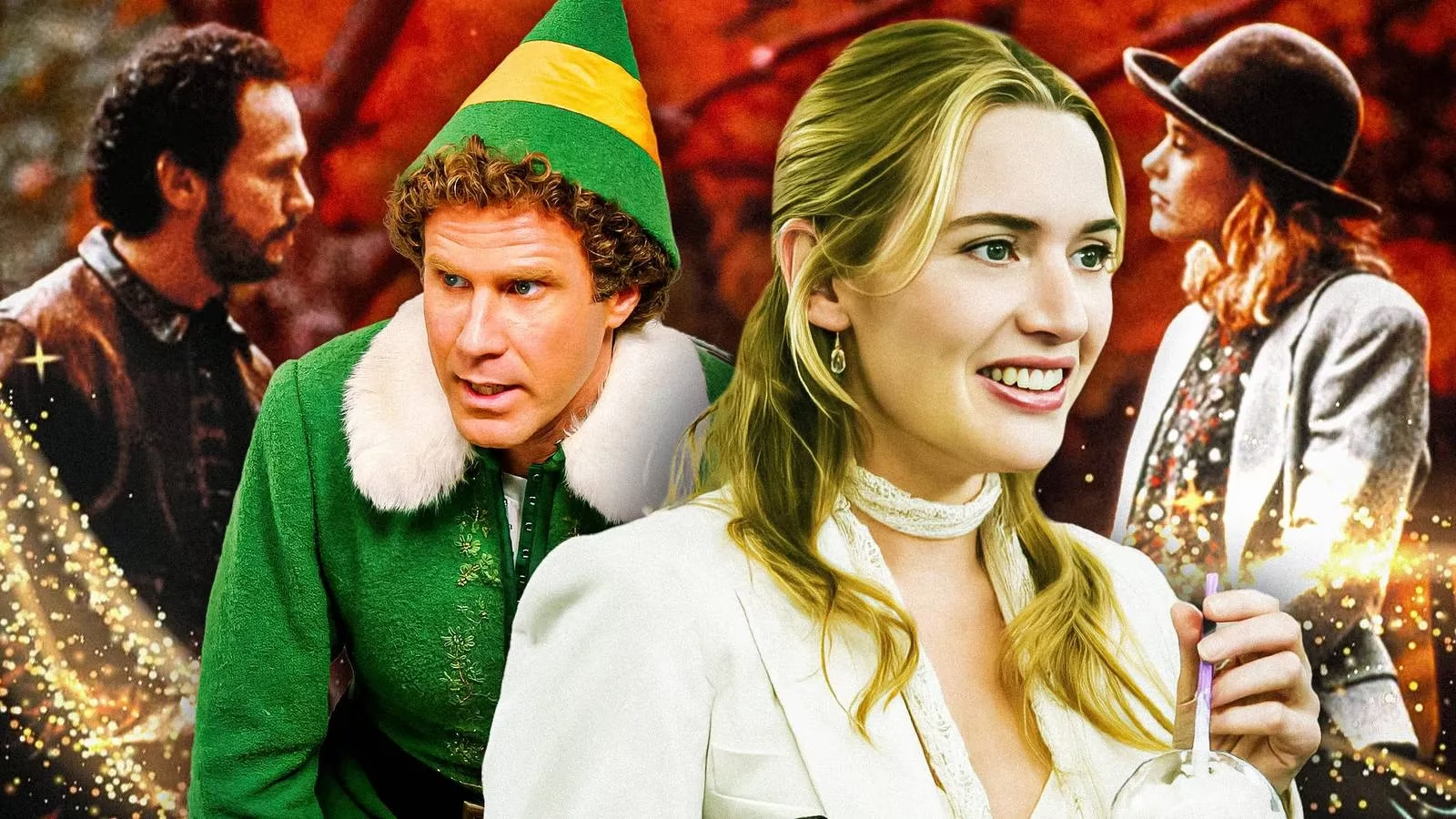
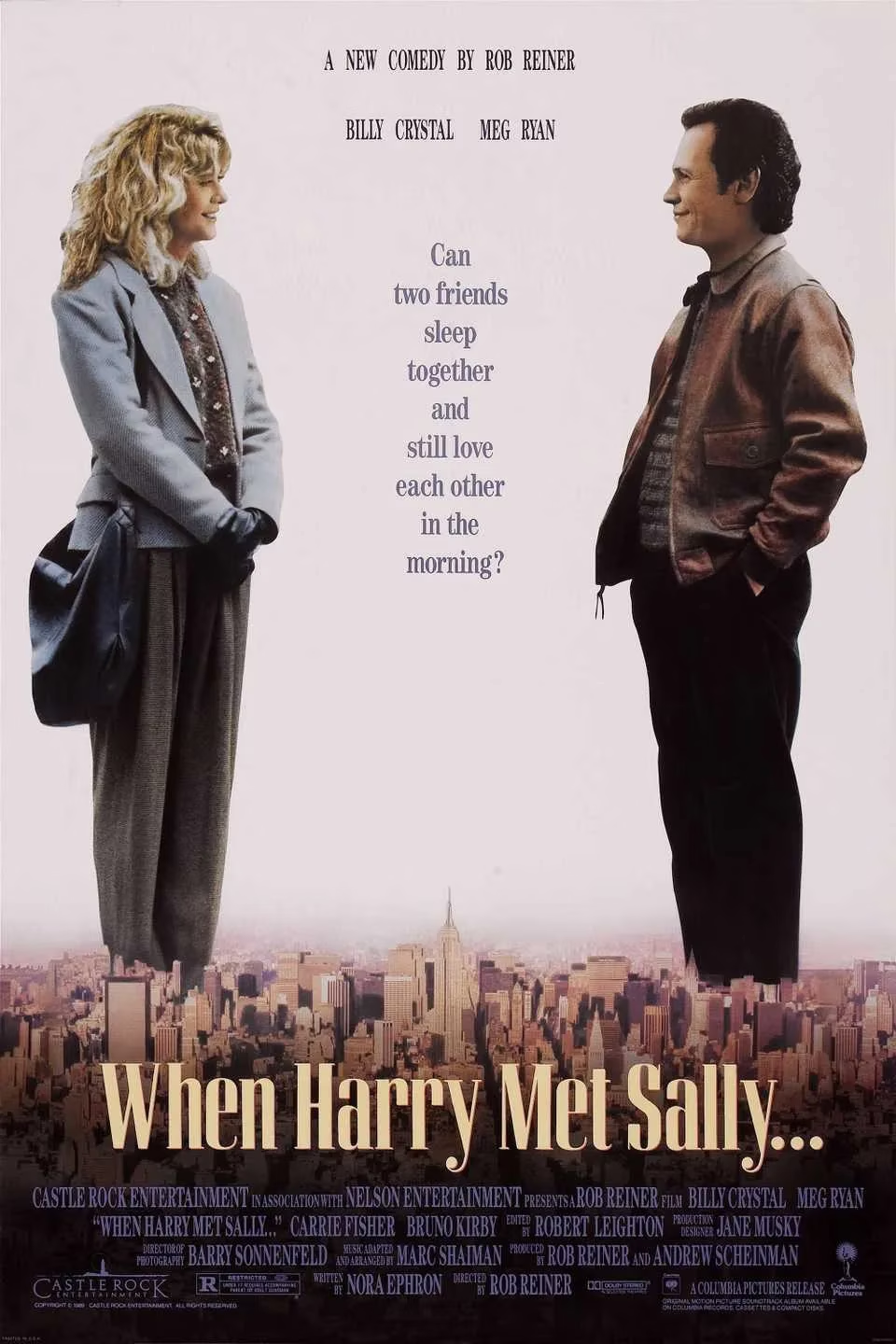
Then comes the 1989 meta-defining patch known as When Harry Met Sally, a film so meticulously scripted it plays like a conversation-heavy visual novel with a 99% clearance rate. Director Rob Reiner and writer Nora Ephron drop you into the decades-long, high-latency friendship between the cynical, pivot-table of a man, Harry (Billy Crystal), and the control-freak algorithm personified, Sally (Meg Ryan). Their journey is a brutal, unflinching deep-dive into the guts of intimacy, a level so punishingly realistic that every dialogue tree feels like a vibroblade to your own romantic history. The chemistry isn’t just good; it’s a synaptic overload. And the atmosphere? New York City in autumn and winter, drenched in Harry Connick Jr.’s jazz, is a sensory mod that turns the entire experience into a lush, melancholic dreamscape. By the time that final, picture-perfect New Year’s Eve kiss hits, sealing a romance delayed by decades of bad timing, you realize this isn’t a movie—it’s a pixel-perfect simulation for the souls brave enough to navigate it.
I almost skipped the 1995 sleeper hit While You Were Sleeping—a critical error that would have cost me a top-tier achievement. This is the ultimate ‘unreliable narrator as a protagonist’ playthrough, powered by a Sandra Bullock performance so charmingly desperate it should be illegal. Lucy, a lonely fare-collection NPC on the Chicago Transit Authority, executes a single, wildly unethical dialogue choice when her longtime crush, Peter, falls into a coma: she lets his entire family believe she’s his fiancée. The ensuing gameplay is a masterclass in tension as the snow piles higher. Her web of lies becomes a suffocating, self-generated dungeon, made infinitely worse by her falling for the actual alpha-build: Peter’s brother, Jack (Bill Pullman). It’s a hilarious and agonizing lesson that you can’t force a romance quick-time event. Love, this film screams over its near-perfect snowy Chicago skyline, is a loot drop from the most unlikely boss—you just have to stop griefing your own save file to find it.
Now, we enter the chaotic, candy-coated raid of 2003’s Elf. Forget its reputation; this is not just a slapstick comedy. It’s a philosophical treatise on the un-skipable tutorial of first love, piloted by Will Ferrell’s Buddy, a human raised by elves who navigates New York City like an explorer with a glitched-out perception filter. His pursuit of Jovie (Zooey Deschanel), a disillusioned department-store Christmas singer, is a marvel. Watching Buddy’s awkward, grammatically catastrophic attempt to ask her out is like observing a creature learning a complex game mechanic for the first time—it’s pure, unfiltered, childlike code. Their romance acts as a mutual buff; Jovie teaches Buddy the meta of the human world, and Buddy restores Jovie’s jaded soul to its factory settings of wonder. The entire relationship is a ludicrous, beautiful reminder that sometimes the most viable build is to simply express your unique passions at maximum volume and see who resonates.
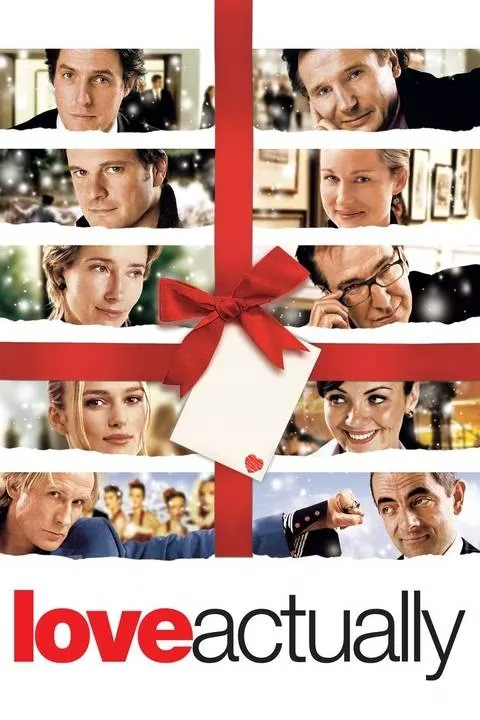
But the anthology film is the true hardcore mode, and 2003’s Love Actually is its undisputed champion. Richard Curtis crafts a multi-thread narrative, a sprawling server of interconnected Londoners all grinding the ‘find love by Christmas’ questline simultaneously. It’s a risk-reward frenzy. Some storylines, like the Prime Minister (Hugh Grant) falling for a staffer, are like a safe, high-damage mage build. Others, like Jamie (Colin Firth) and Aurélia’s (Lúcia Moniz) romance across a language barrier so thick it’s a firewall, are the equivalent of a naked, no-hit run—insanely risky, but the payoff is a pure, uncut emotional nuke. The theme is brutal in its simplicity: boldness and honesty are not just stats to consider; they are the only weapons in your inventory when facing an emotional gatekeeper, regardless of the outcome.
2006’s The Holiday presented the house-swap mechanic, a genre innovation I initially dismissed. Amanda (Cameron Diaz), a high-level Los Angeles ‘cutscene-skip’ expert who cannot cry, and Iris (Kate Winslet), an overly emotional Surrey journalist whose tear ducts are permanently on cooldown, trade save files. What follows is a bi-continental romance speedrun. Amanda encounters Jude Law’s Graham, a character so disarmingly charming he functions as a walking, talking ‘Instant Win’ cheat code disguised as a handsome English book. Meanwhile, Iris’s slow-burn quest with Jack Black’s composer is a beautiful example of emotional friendship grinding that eventually unlocks a romantic achievement. The game design here is flawless, showing that swapping your environment is sometimes the only way to debug your corrupted romantic subroutines, and that a platonic sidekick can be just as powerful a reward.
And then there’s the chaotic four-player franchise mode of 2008’s Four Christmases. This is a relentless, anxiety-inducing speed level where a happily unmarried, child-free duo, Brad (Vince Vaughn) and Kate (Reese Witherspoon), are forced to raid all four of their divorced parents’ houses in a single, disastrous day. Each home is a uniquely themed battleground of slapstick humiliation and familial cringe, throwing waves of quirky, judgmental NPCs at the couple. The brilliance is that the external chaos functions as a weaponized debuff, forcing them to confront the very concept of their own relationship as an unstable alliance. The victory condition here is profound: a successful partnership isn’t about dodging the AoE attacks of your combined family dysfunctions, but about learning to taunt and absorb them together as a single, chaotic unit.

In 2019, Last Christmas patched in a wildly experimental genre-bend: the Wham!-core emotional sabotage module. It stars Emilia Clarke as Kate, a burned-out healer-class character who works a dead-end job in a year-round Christmas store in London, still suffering a massive HP drain from a heart transplant. Enter Tom (Henry Golding), a mysterious, seemingly over-optimistic NPC who keeps spawning in her path. For 90% of the runtime, you think this is a standard rom-com with a charmingly annoying rogue. Then, the game drops its seismic plot twist like a meteor: Tom is the literal, tangible manifestation of the heart now beating in her chest, belonging to the donor who died in the same accident. It’s a narrative logic bomb that retroactively transforms the entire film into a poignant, grief-riddled masterpiece. The mission isn’t just about romance; it’s about accepting one’s patched, scarred, and deeply broken internal hardware.
Then came the 2020 new-class release, Happiest Season, a title that shattered the hetero-normative server with a revolutionary patch. Directed by Clea DuVall, this stealth-action drama stars Kristen Stewart as Abby, who enters the ultra-hostile environment of her closeted girlfriend Harper’s (Mackenzie Davis) conservative family for the holidays. It is the ‘social survival horror’ expansion we never knew we needed. Harper’s frantic, hilarious, and deeply painful tactics to dodge discovery while Abby’s patience is ground into dust create a high-stakes pressure cooker. The addition of Aubrey Plaza as the chaotic-neutral Riley is a legendary guest-star power play. The final boss fight is Harper choosing to come out, a declaration that makes the ultimate final-season statement: everyone deserves to love honestly and openly, and any build that asks you to play through the holidays with a cloaking device is a broken mechanic.
Finally, we arrive at the 2021 post-ironic meta-run, Love Hard, a film that understands the 2026 dating-app hellscape better than most modern titles. Nina Dobrev plays Natalie, a writer from Los Angeles who falls for a catfishing trap laid by the master-troll Josh (Jimmy O. Yang) on the East Coast. The deal they strike—she pretends to be his girlfriend to impress his family if he introduces her to the actual avatar he used in his profile—is a carousel of cringe-comedy perfection that predictably detonates on Christmas Day. For anyone whose heart has been a punching bag for algorithmically-suggested soulmates, this film is a validating and gut-busting power-up. It hacks into the central server to deliver its payload: love isn’t a curated flawless profile, but an unscripted, glitchy, and natural co-op experience that requires dropping the cheat codes of deceit.