How an Improvised Hand Flex Redefined Enemies-to-Lovers in Period Pieces
It’s a moment so fleeting that a blink might miss it, yet it has sparked countless memes, fan edits, and even academic-style video essays. In the 2005 adaptation of Pride & Prejudice, Mr. Darcy helps Elizabeth Bennet into a carriage, their bare hands briefly touching—a scandalous slip in the buttoned-up Regency era. He turns, walks away, and then it happens: his right hand flexes, fingers stretching and curling as if he’s been scorched. No words, just a tiny physical spasm that says everything. Over two decades later, that split-second gesture remains a masterclass in restrained longing and has quietly reshaped how screenwriters and actors build enemies-to-lovers tension across an entire genre.
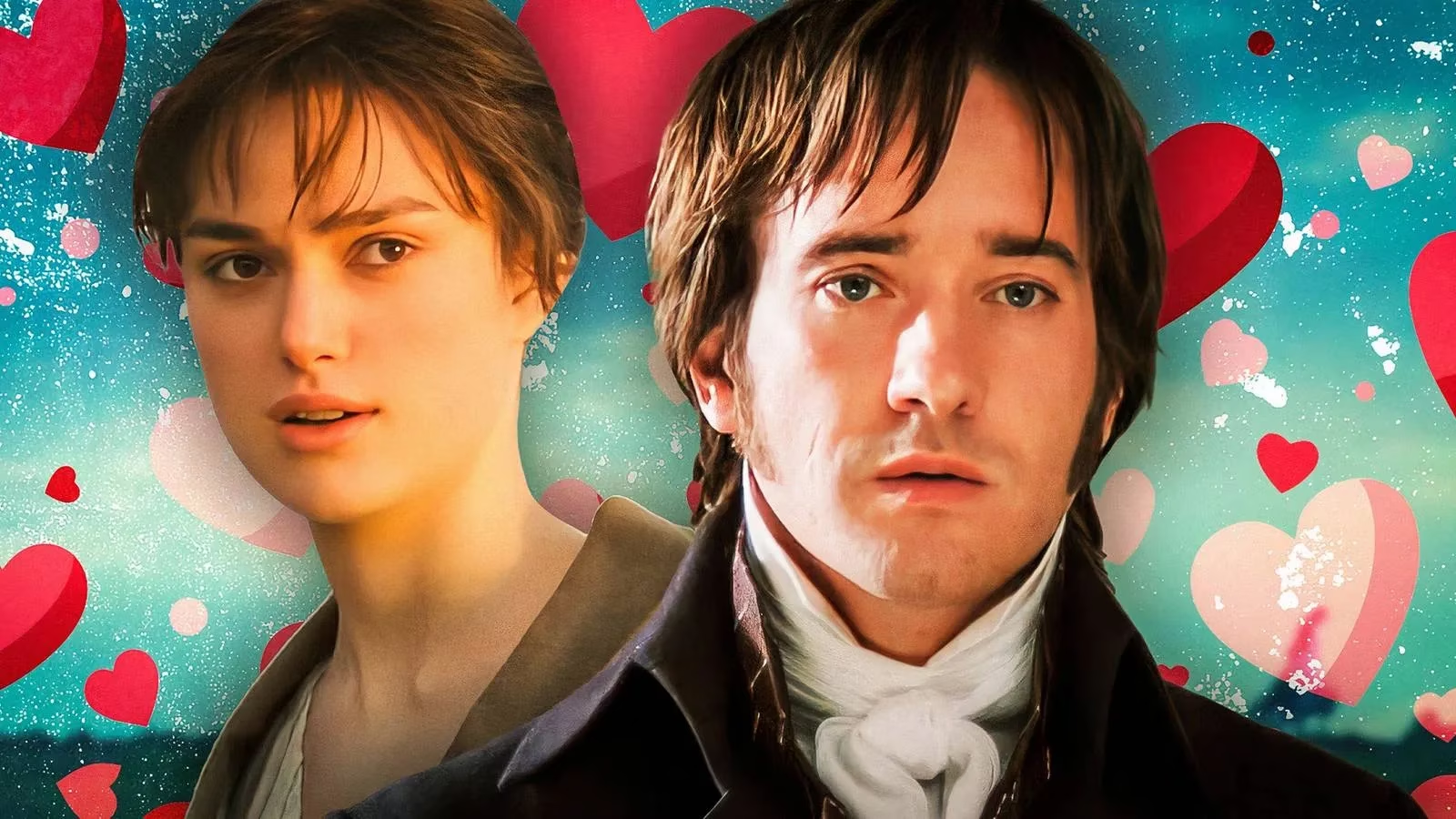
The story behind the flex is as charming as the scene itself. Matthew Macfadyen, who played Darcy opposite Keira Knightley's razor-sharp Elizabeth, once confessed he was initially wary of taking on a role so famously inhabited by Colin Firth in the BBC miniseries. During rehearsals, Macfadyen improvised that little hand adjustment, purely on instinct. Director Joe Wright adored it so much that he choreographed a deliberate close-up shot to catch the movement in the final cut. What could have been a throwaway beat became the emotional linchpin of the entire film. Critics certainly didn\u2019t mind Macfadyen\u2019s earlier hesitation: the movie still holds a sparkling 87% critic score on Rotten Tomatoes, but among fans, the hand flex is the true star.
The magic lies in its inversion of period romance clich\u00e9s. British costume dramas are drenched in repression, where men stand stoic and women wait in parlors. Here, however, Darcy\u2014the embodiment of proud restraint\u2014comes undone. There\u2019s no confession, no dramatic kiss in the rain. Just a hand that betrays him. It\u2019s a rare instance of a male lead visibly struggling to contain his feelings, and audiences have never gotten over it. Social media turned the flex into a phenomenon all over again, especially after the scene was lovingly referenced in Greta Gerwig\u2019s 2023 Barbie and as shows like Bridgerton brought period pieces roaring back into pop culture\u2019s center stage.
The ripple effect on modern period dramas
That single improvisation has evolved into a storytelling blueprint. When writers want to show emotional cracks in a seemingly cold hero, they now reach for a physical tell\u2014a modern-day descendant of the Darcy flex. Netflix\u2019s Bridgerton ran with this idea spectacularly in its second season. Anthony Bridgerton and Kate Sharma spar, snipe, and resist each other across ballrooms and gardens until their animosity curdles into attraction. The series gives its own nod to the hand flex with a moment where Anthony secretly inhales Kate\u2019s perfume scent, a slip Lady Danbury wickedly catches. It\u2019s the same electric charge of unspoken desire, adapted for a steamier age.
A more chaotic take arrives in Hulu\u2019s The Great, a wildly irreverent historical dramedy about Catherine the Great. Catherine and her husband Peter truly hate each other\u2014she literally plots a coup\u2014but as the slow-burn romance builds, Nicholas Hoult\u2019s mercurial Peter begins to soften. His precise facial micro-expressions, not a hand this time but a subtle crumbling around the eyes, do the work. The echo of Macfadyen\u2019s instinct is plain: give the audience an almost unconscious gesture that leaks the truth when words won\u2019t.
Perhaps the most direct homage comes from Amazon Prime Video\u2019s fantasy romance My Lady Jane, which sets an enemies-to-lovers arc inside a reimagined Tudor England. Star Emily Bader, who plays a survival-minded Lady Jane Grey, told Entertainment Weekly that she and costar Edward Bluemel actively studied Pride & Prejudice for inspiration. The research manifests in Bluemel\u2019s tiny head shake during the wedding scene\u2014a nervous, human crack in a composed facade\u2014and Bader\u2019s bold, forward energy that mirrors Elizabeth Bennet\u2019s defiance. The show\u2019s acclaim is just the latest proof that the 2005 film remains a foundational text.
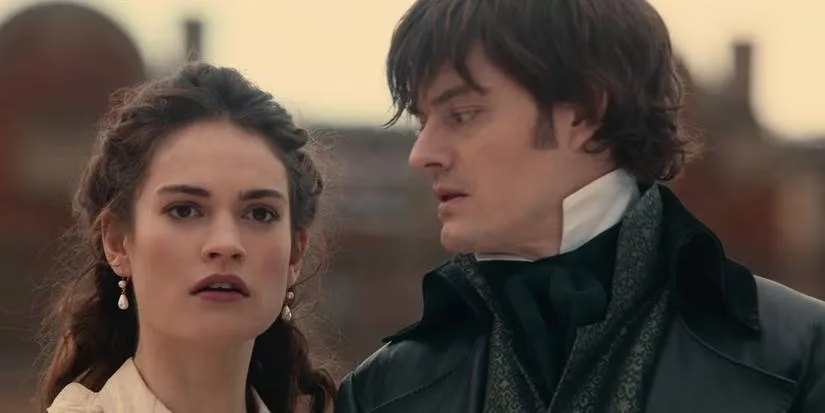
Even genre-bending oddities owe a debt. The bonkers Pride and Prejudice and Zombies, a mashup that pits Regency romance against the undead, still keeps the emotional core intact. Sam Riley\u2019s zombie-slaying Darcy and Lily James\u2019s fierce Elizabeth carry the same combative spark, proving that the dynamic works with corsets and corsets-adjacent action alike.
Why it still works two decades later
In 2026, with countless bingeable period shows at our fingertips, the hand flex\u2019s enduring power lies in its simplicity. It understands that the most volcanic passions are often the quietest. Audiences are exhausted by oversharing and on-the-nose dialogue; they gravitate toward moments that trust them to see. Macfadyen\u2019s flex is pure visual subtext, a language that doesn\u2019t age. Period pieces remain obsessed with grandeur\u2014gowns, palaces, sweeping scores\u2014but the flex proved that a single, unguarded second of body language can be more devastating than any grand declaration.
So next time you spot a duke\u2019s jaw tightening or a lady\u2019s glove slipping intentionally, you know where it started. Not in the pages of Austen\u2014though she planted the seed\u2014but in a nervous actor\u2019s rehearsal-room instinct that captured how it truly feels to fall when you\u2019re trying hardest not to.