Classic Movies Save Cinemas: How Pride & Prejudice and Revenge of the Sith Prove Old Hits Are New Gold
You know, as someone who loves movies and has watched the industry change over the years, I find what's happening right now absolutely fascinating. Here we are in 2026, and movie theaters have been facing what feels like an existential crisis for most of this decade. The streaming revolution changed everything—why leave your couch when you can watch anything at home? But then something unexpected happened. A 20-year-old romance film, Pride & Prejudice, returned to theaters for its anniversary and became a genuine box office hit. Again. It wasn't alone either. Star Wars: Revenge of the Sith did the same thing. This isn't just nostalgia; it feels like a lifeline for cinemas, and I think it points toward a smarter future for Hollywood.

Let me break down what happened. For the busy Easter weekend, the 2005 adaptation of Pride & Prejudice with Keira Knightley and Matthew Macfadyen quietly opened at number six. But here's the crazy part: over its 11-day special run, it actually climbed to number three at the domestic box office! It ended up pulling in nearly $6 million. Now, that might not sound like Avengers money, but context is everything. That total represents about 15% of what the film made in its entire initial domestic run back in 2005. For a re-release in the modern era, that's almost unheard of success.
And it wasn't a fluke. That same month, Star Wars: Revenge of the Sith also came back. That film, which originally made nearly a billion dollars globally, managed to add over $50 million during its re-release. It consistently stayed in the top four, even beating out brand-new releases. The scale is different, but the message is the same: people are willing to pay to see these classics on the big screen, decades later.
So, why is this working now, in 2026, when theaters are supposedly dying? I have a few theories based on what I've seen and felt myself.
First, it's about the experience you can't get at home. Watching Pride & Prejudice in a theater is completely different. That iconic scene where Mr. Darcy walks through the morning mist? The swelling score during the first dance? You feel it in your bones in a way a TV speaker can't replicate. It’s an event. For Revenge of the Sith, it's the roar of lightsabers and the epic scale of the Battle of Coruscant. Streaming gave us convenience, but it also made us realize what we were missing.
Second, it's communal nostalgia with a purpose. It's not just about seeing the movie again. It's about sharing it. I went to see Pride & Prejudice with friends who love it as much as I do, and the theater was full of people who were whispering the lines, laughing at Mr. Collins, and collectively swooning. It was a shared celebration of something we all loved. For Star Wars, it's a generation introducing their kids to the saga the way it was meant to be seen.
Third, and this is crucial for the industry, it's a smart financial model. Look at the math. The cost of marketing and distributing a re-release is a fraction of producing a brand-new, risky blockbuster. It's a relatively low-cost, high-reward strategy that generates pure profit. This isn't just about making quick cash, though. That profit can be reinvested. It can fund the kind of mid-budget, director-driven films that have almost disappeared—exactly the type of film Pride & Prejudice was. It's ironic, really. A movie that might struggle to get a green light today is helping to create a financial buffer that could allow more like it to be made.
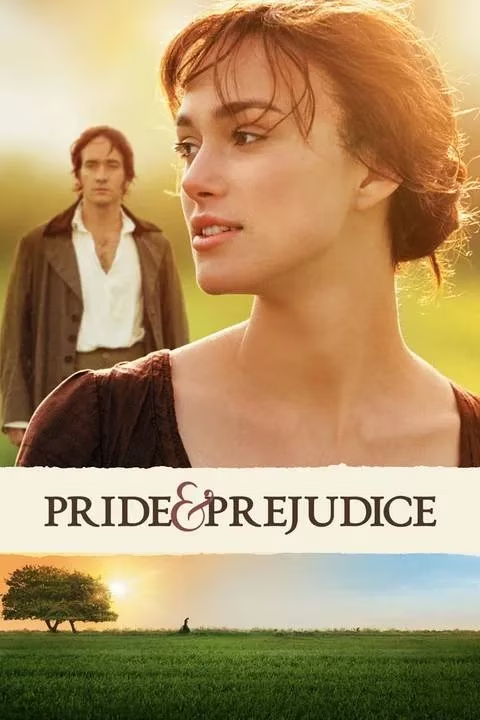
Let's compare these two re-release champions:
| Film | Original Release | 2026 Re-Release Gross | Key to Success |
|---|---|---|---|
| Pride & Prejudice | 2005 | ~$6 Million | Cultural milestone, timeless romance, event viewing |
| Star Wars: Episode III | 2005 | ~$50 Million | Fan-driven saga, iconic spectacle, generational appeal |
Both prove there's a viable path forward. The strategy shouldn't be to re-release everything, but to be selective and strategic. Think about anniversaries, director's cuts, or films tied to current cultural moments. The goal is to make going to the movies feel special again.
Honestly, seeing this success gives me hope. The middle ground in filmmaking—those thoughtful, well-crafted stories that aren't cheap indies or $300 million gambles—has been eroding. If the reliable revenue from re-releases of proven classics can help stabilize studios, maybe they'll be more willing to take chances on new stories in that vein. It creates a healthier ecosystem.
In the end, what the success of Pride & Prejudice and Revenge of the Sith tells us is simple: Great movies are timeless, and the desire to experience them together in a theater never really went away. It just needed the right opportunity to remind us. For an industry looking for answers, the past might just hold the key to its future. The challenge now is to listen to what audiences are clearly saying with their tickets: we value the shared, big-screen experience, especially for stories that have stood the test of time. Let's hope Hollywood is paying attention.