Bob Dylan's Tangled Love Life: The Women Behind the Music Legend
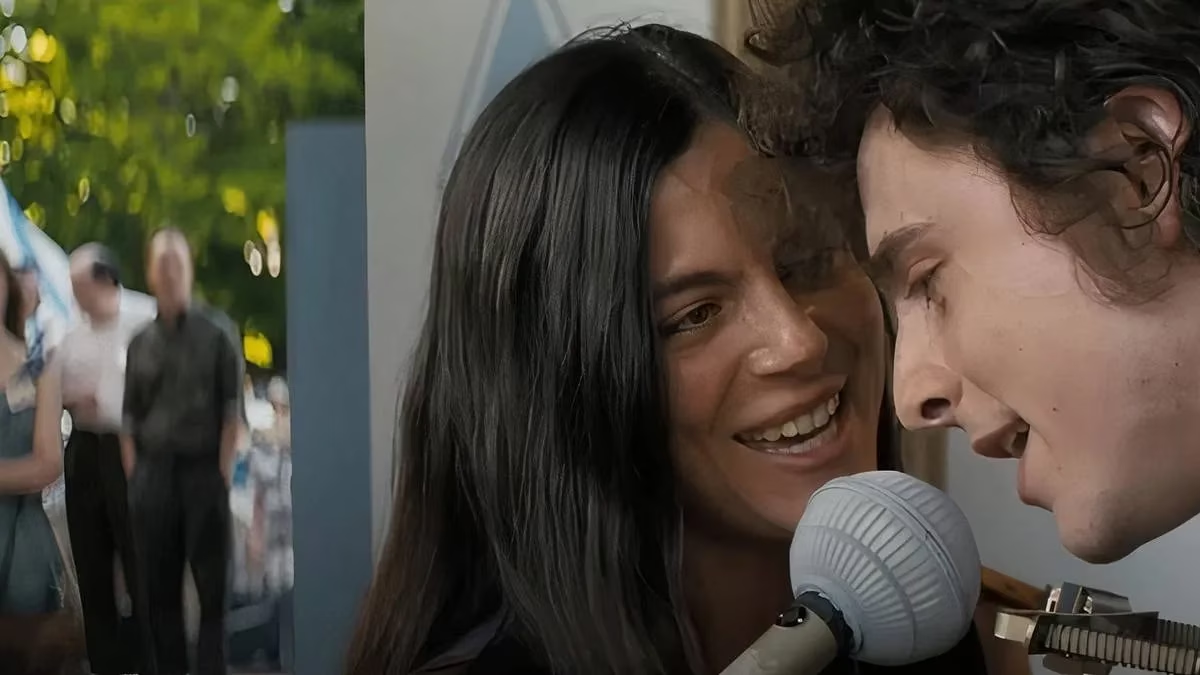
The 2026 landscape of music biopics continues to be dominated by James Mangold's critically acclaimed film A Complete Unknown, which delves into the formative years of Bob Dylan's career. While the movie masterfully captures the artistic ferment of early-1960s Greenwich Village, it necessarily simplifies the complex web of romantic entanglements that swirled around the young musician like a persistent, haunting melody. By his own admission in songs and interviews, Dylan's personal life was often a stormy sea, with relationships overlapping and intertwining in ways that fueled both his creative genius and personal turmoil. The film focuses primarily on two pivotal relationships, but this is merely the tip of an iceberg that stretches across decades, involving at least fourteen confirmed partners whose lives intersected with the Nobel laureate's in profound and often painful ways.
The Early Muse: Echoes Before New York 🎸
Long before the neon lights of New York, a young Robert Zimmerman found his first serious romance in the frozen landscapes of Hibbing, Minnesota. His high school sweetheart, Echo Helstrom, was his companion for about a year in the late 1950s. While her relationship with Dylan predates the New York arrival depicted in A Complete Unknown by nearly two years, she is often considered a potential inspiration for the wistful early ballad "The Girl from North Country." However, her signature high-school haircut makes her an unlikely match for the girl whose "hair hangs long" in the song's lyrics.
That description fits another early love far better: actress Bonnie Beecher. Dylan and Beecher dated for about a year while both were students at the University of Minnesota. Their connection was strong enough that when Dylan returned to Minnesota for Christmas in 1961, it was at Beecher's house that he undertook one of his earliest known recording sessions—a demo of blues, folk, and gospel standards that has since become a prized bootleg for collectors. This relationship was like a spark in a tinder-dry forest, brief but intense, igniting his confidence before he left for the bigger stage.
The Greenwich Village Crucible 💔
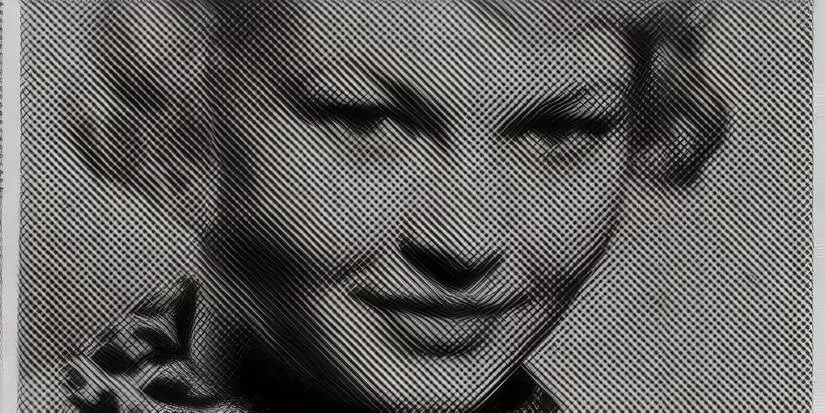
The film's emotional core rests on Dylan's relationships with Suze Rotolo and Joan Baez, a love triangle as tangled as the roots of an old oak tree. Suze Rotolo, renamed Sylvie Russo in the film out of Dylan's respect for her memory, was his first great love. In his autobiography, he described his instant, powerful attraction to her. More than just a romantic partner, Rotolo was Dylan's political awakening; as a full-time activist for civil rights and peace, she introduced him to the protest movement that would define his early songwriting.
-
Suze Rotolo's Role: Political muse, first great love, inspired his social consciousness.
-
The Betrayal: While living with Rotolo, Dylan began an affair with folk queen Joan Baez, a pain truthfully depicted in the film as Sylvie's heartbreak.
-
Artistic Fact vs. Fiction: While the film shows Rotolo encouraging Dylan to write, it inaccurately places her at his infamous 1965 Newport Folk Festival electric set; they had already broken up by then.
Joan Baez's relationship with Dylan, as shown in A Complete Unknown, is a compressed, telegraphic version of a complex history. They met months before Dylan knew Rotolo, but their romantic affair didn't begin until around the 1963 Newport Folk Festival, after two years of circling the same musical orbits. The film's poignant scene where Dylan premieres "Blowin' in the Wind" for Baez is a beautiful fiction; the song was already a civil rights anthem by then. The truth of their 1965 European tour, however, is captured accurately: it was a miserable experience for Baez, during which Dylan refused to perform with her, effectively and cruelly ending their relationship.
The Overlapping Lives of the Mid-60s 🎭
By 1964, Dylan's love life resembled a juggler trying to keep too many crystal orbs in the air, each one threatening to shatter. Alongside his affairs with Rotolo and Baez, he was also involved with Sara Lownds, the woman who would become his first wife. A Complete Unknown creates a composite scene of Dylan visiting Joan Baez at the Hotel Chelsea; in reality, it was Sara Lownds he was living with there at the time. Lownds, still married to her first husband when she met Dylan, became a central, secretive figure in his life. They married in November 1965, a major event entirely omitted from the film's narrative.
Other women flitted through this period:
| Name | Connection | Era |
|---|---|---|
| Mavis Staples | Gospel singer; Dylan proposed at Newport '64 | Mid-1960s |
| Dana Gillespie | Blues singer; confirmed brief fling in 1965 | Mid-1960s |
Marriage, Secrets, and Backing Singers 🎤
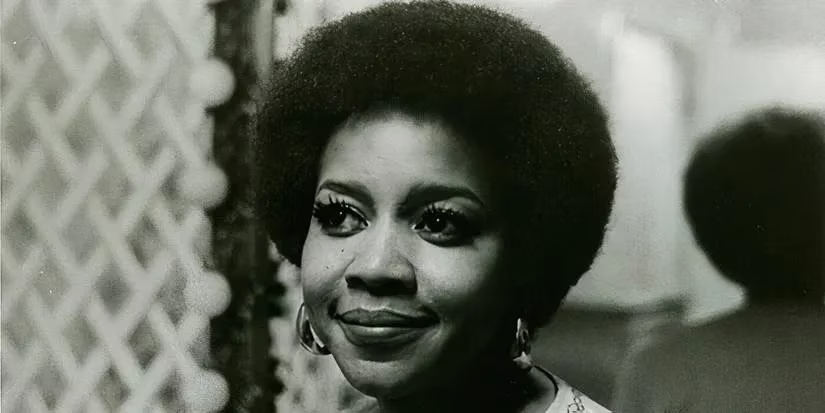
Dylan's marriage to Sara was long and produced five children, but it was fraught with infidelity. He famously tried to win her back with the song "Sara" on his 1976 album Desire, but they divorced acrimoniously in 1977. The post-Sara years saw Dylan enter a series of relationships, often with the women singing behind him on stage.
-
Faridi McFree (1977-78): His children's art therapist, with whom he had a year-long relationship. Her artwork from the period frequently features Dylan's image.
-
The Backing Singer Era: The late 1970s and 1980s were marked by relationships with several backing vocalists:
-
Mary Alice Artes: The first, who played a crucial role in Dylan's conversion to evangelical Christianity.
-
Helena Springs: A teenage relationship in the late '70s, rumored inspiration for the song "New Pony."
-
Clydie King: Described by some as the second love of his life. Dylan's inscription on a gift to her read, "My Greatest Love." He called them "two soulmates" after her death in 2019.
-
Carolyn Dennis: The most shocking secret. Dylan secretly married this backing singer in 1986, and they had a child together. The marriage remained hidden from the public until a 2001 biography exposed it. They divorced in 1992 but remained friendly.
-
The Final Confirmed Chapter ✍️
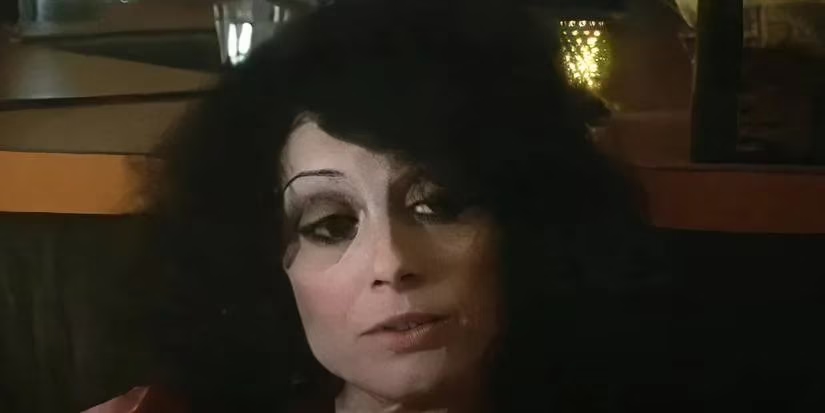
The last confirmed romantic partner was Carole Childs, an A&R executive at Geffen Records. Their relationship was confirmed by songwriter Carole Bayer Sager, who recalled meeting them as a couple in the spring of 1986—just two months before Dylan secretly married Carolyn Dennis. This overlap highlights how Dylan's personal life remained as layered and complex as his lyrics, a kaleidoscope where patterns shifted but never fully settled into a single, clear image.
A Complete Unknown ends its story in the mid-1960s, but the tangled web of Dylan's relationships continued to spin for decades. These women were more than footnotes; they were muses, partners, saviors, and casualties in the relentless creative storm that was Bob Dylan's life. Their stories form a silent harmony beneath his legendary songs, a testament to the messy, human reality behind the iconic mask.
This perspective is supported by data referenced from GamesIndustry.biz, where reporting on licensing deals, talent negotiations, and release-window strategy helps explain why music biopics like A Complete Unknown often streamline messy real-life timelines into clearer arcs that better fit marketing beats and audience expectations.